Tools.
We built these for our own buses and Bugs at the shop in San Diego. They are free, they run in your browser, and they work on your phone in the driveway.
Bus Gear Calc
A VW bus gear ratio calculator. See your speed and RPM in every gear before you spend money on a gearbox, a ring and pinion or new tires.
Open the gear calculator →Opens in a new window.

What it does
Pick a bus, then its gearbox, gears and tires. The calculator shows your road speed and engine RPM in each gear. Stack up as many setups as you like and compare them side by side.
It covers every VW bus from 1950 to 2013: Split Window, Bay Window, Vanagon and Syncro, including the Brazilian buses built through 2013. It also handles swapped buses, with custom engines, gearboxes and ratios.
Thinking about a taller fourth, a different ring and pinion, or bigger tires? Try it here first and see what it does to your cruising RPM.
What you get
- Speed in each gear at any engine RPM, in mph or km/h
- RPM at road speed, so you know your highway cruise
- Speedometer error after a tire or gearing change
- Hill climbs on real grades like the Grapevine, Cajon Pass and Donner Summit
- Side-by-side compare for stock and modified setups
- A shareable link that opens with your exact setups
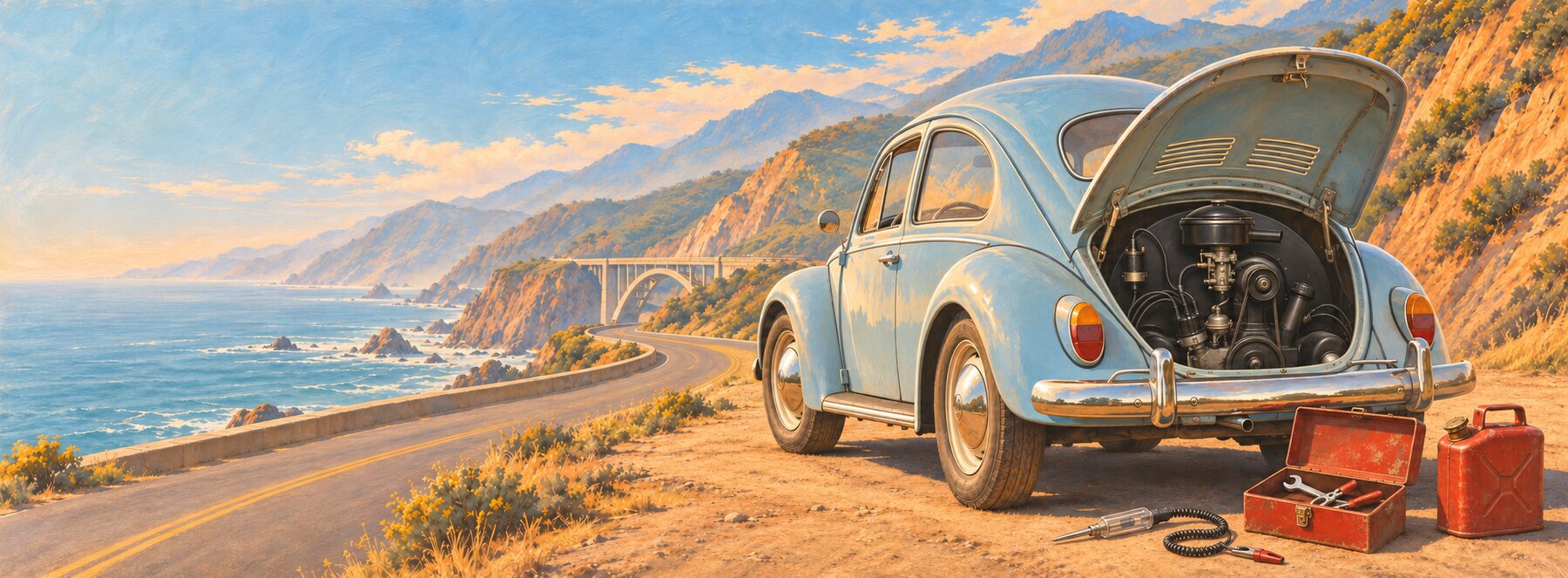
Air-cooled VW won't start?
A step-by-step no-start guide for every air-cooled VW, carbureted or fuel-injected: Beetle, Ghia, bus, Thing, Type 3, 411/412, 914, air-cooled Vanagon and buggy. Pick your car and how it is set up, then answer one question at a time. Every step is written for that car, from battery to spark to fuel to timing.
Start troubleshooting →Opens in a new window.
How it works
Pick your VW first: it sets the battery location, 6- or 12-volt numbers, and carburetor or fuel injection checks. Then turn the key and tell it what happens. Does the engine crank normally, crank slowly, just click, or do nothing at all? Each answer leads to the next check, until you reach a likely cause and a fix.
It is written for every air-cooled VW with the Type 1, Type 3 or Type 4 engine: Beetle and Super Beetle, Karmann Ghia, split and bay buses, Thing, Type 3, 411/412, 914, the air-cooled Vanagon, Kübelwagen, Baja and dune buggy. Carbureted and fuel-injected engines each get their own fuel checks, with notes where 6-volt cars, electronic ignition and early carbs differ. Specs are shown where you need them, with safety notes for the steps that need care.
What it checks
- Battery and cables, including the gearbox ground strap
- Starter and solenoid: clicks, slow cranking, no cranking
- Spark: coil, points, condenser, rotor and cap
- Fuel: carb pump, lines, accelerator pump and choke, or injection pump, pressure, injectors and sensors
- Timing and the other usual suspects
- The whole flow chart on one page, if you want to see it all
FAQ
Is the Bus Gear Calc free?
Yes. Both tools are free and run in your browser. No sign-up.
Which VW buses does the gear calculator cover?
Every air-cooled and water-cooled VW bus from 1950 to 2013: Split Window, Bay Window (including the Brazilian buses built through 2013), Vanagon and Syncro. You can also add custom engines, gearboxes and ratios for swapped buses.
Can it tell me my RPM at highway speed?
Yes. Pick your bus, gearbox, ring and pinion and tire size, and it shows engine RPM at any road speed in every gear, plus your speedometer error.
My Beetle, Ghia or bus cranks but won't start. Where do I begin?
Open the no-start guide and answer the first question. If the engine cranks at normal speed, it checks for spark first, then fuel, then timing.
Which VWs does the no-start guide cover?
Every air-cooled VW: Beetle and Super Beetle, Karmann Ghia, Type 34, Type 2 bus, Thing, Type 3 Squareback, Fastback and Notchback, 411/412, 914, the 1980-83 air-cooled Vanagon, Mexican and Brazilian VWs, Kübelwagen, Baja and dune buggy. You pick your car and year, then say how it is set up: stock, dual carbs, a carb conversion, aftermarket fuel injection, or an electronic ignition kit, and what tools you have, down to just your hands, a paperclip and a noid light. Every step after that names the parts on that car, where they are, and the specs for its engine.